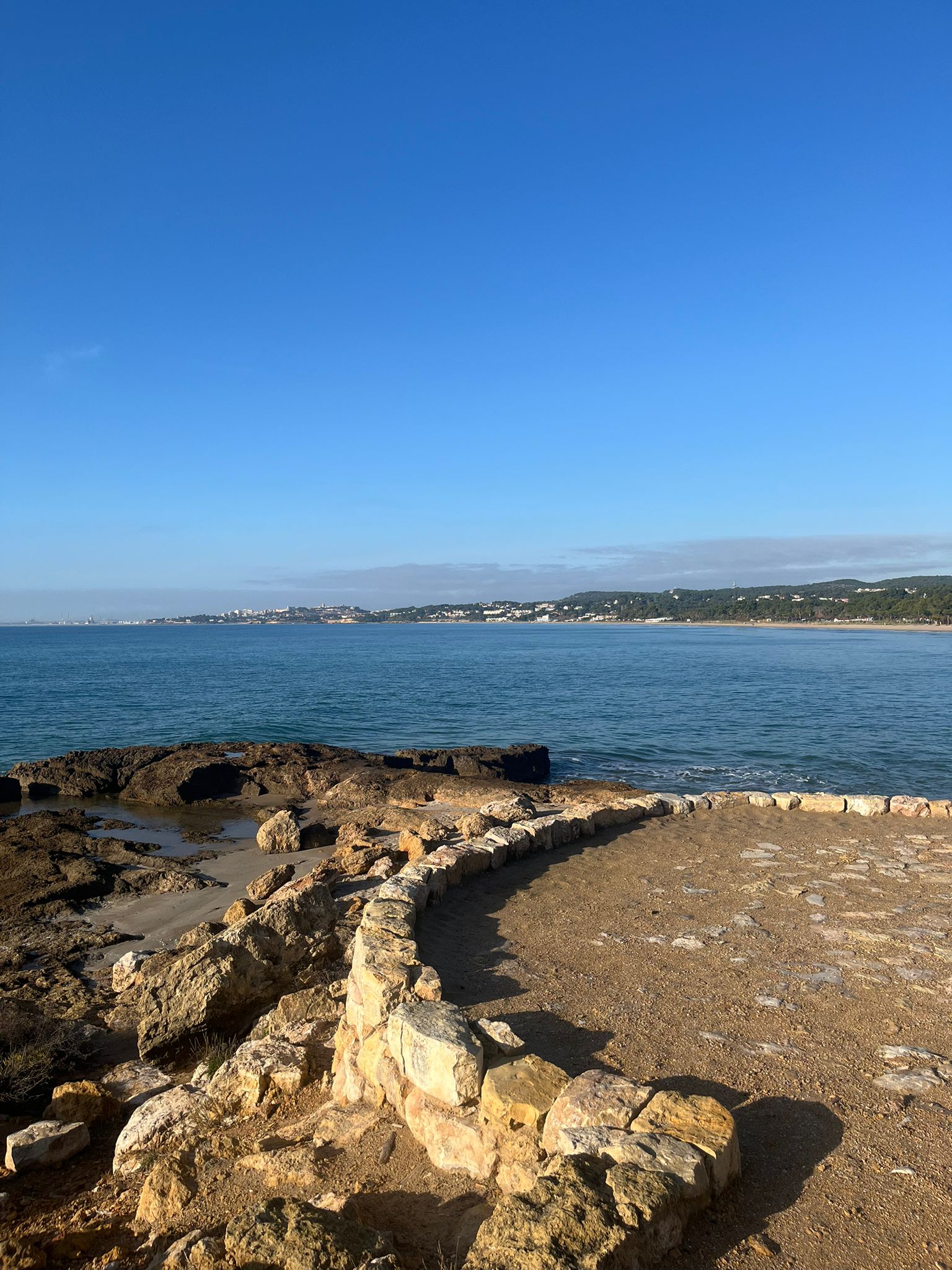
Punta de la Creueta<p style="text-align: justify;">The Roman quarry of <strong>Punta de la Creueta</strong> is an old stone quarry located next to the sea, north of Platja Llarga, which supplied blocks for construction in the area around Tarraco, taking advantage of the same bioclastic limestone vein as that of Mèdol. Its stone, with golden and reddish tones, with visible fossils, was particularly suitable for ashlars and building blocks. The extraction activity dates back to the beginning of the 1st century AD and is linked, among others, to the Scipio Tower, located about 580 meters away.</p> <p style="text-align: justify;">The marks of Roman work can still be seen on the rock: stepped fronts, grooves cut into the rock, wedge-shaped inserts, negative molds of the extracted blocks and pieces abandoned due to internal fissures. Part of the quarry is submerged, which makes it difficult to calculate its exact size, estimated at about 1,500 m³. There is no evidence of subsequent exploitation, although during the Civil War a Republican watchtower with trenches was established there, still visible. Today, the quarry is a site of geological and historical interest that exceptionally preserves the direct footprint of Roman stonemasons in a very well-preserved coastal environment, offering valuable information on extraction techniques and the ancient landscape of Tarraco.</p>https://rutes-content.tarragona.cat/en/punta-de-la-creuetahttps://rutes-content.tarragona.cat/@@site-logo/logo_aj_tgna.png
Punta de la Creueta
<p style="text-align: justify;">The Roman quarry of <strong>Punta de la Creueta</strong> is an old stone quarry located next to the sea, north of Platja Llarga, which supplied blocks for construction in the area around Tarraco, taking advantage of the same bioclastic limestone vein as that of Mèdol. Its stone, with golden and reddish tones, with visible fossils, was particularly suitable for ashlars and building blocks. The extraction activity dates back to the beginning of the 1st century AD and is linked, among others, to the Scipio Tower, located about 580 meters away.</p> <p style="text-align: justify;">The marks of Roman work can still be seen on the rock: stepped fronts, grooves cut into the rock, wedge-shaped inserts, negative molds of the extracted blocks and pieces abandoned due to internal fissures. Part of the quarry is submerged, which makes it difficult to calculate its exact size, estimated at about 1,500 m³. There is no evidence of subsequent exploitation, although during the Civil War a Republican watchtower with trenches was established there, still visible. Today, the quarry is a site of geological and historical interest that exceptionally preserves the direct footprint of Roman stonemasons in a very well-preserved coastal environment, offering valuable information on extraction techniques and the ancient landscape of Tarraco.</p>